The short answer
To junk a car for cash, estimate its value, find the title, your photo ID and any lien release, and compare offers on what you'd get after towing. At pickup, sign the title as the seller and get paid before the car leaves. Then handle the plates, file your state's notice of sale and cancel the insurance.
Junking a car means selling it to a buyer who will recycle it or pull its parts. You're paid for the metal and anything worth reselling, the buyer tows it away, and you sign the title over. Whether you say "junk my car," "scrap my car" or "sell it to a junkyard," the steps are the same.
In many states, the paperwork you file after the sale is what keeps later tickets and towing bills from landing on you.
How do you junk a car, step by step?
- Decide whether the car is junk or worth fixing.
- Estimate what it's worth from its weight and parts.
- Gather the title, your photo ID and any lien release.
- Get offers and compare what you'd actually receive after towing.
- Clear out the car and schedule the pickup.
- Sign the title in the seller's section, with the odometer reading if it's required.
- Get paid before the car is loaded.
- Handle the plates, file your state's notice of sale and cancel the insurance.
Is your car junk or worth fixing?
A car is junk when the repair it needs costs more than the car is worth, or when no one would buy it to drive. Our guide to selling a car with a blown engine uses a rule of thumb: if the repair would cost more than about half of what the car would be worth running, selling it as-is is usually the better deal.
Get a written repair quote, then look up what the car would sell for running at its age and mileage.
How much will you get to junk a car?
Most junk cars are priced by weight: the car's curb weight in tons times the going price per ton for complete cars, about $186 in November 2026. At that rate, the metal in a compact car is worth roughly $250, a midsize sedan $310, an SUV $390 and a pickup $450.
Cars that still run, or are less than about ten years old, often bring more because their parts resell. A missing engine, transmission or catalytic converter brings the number down. When you're selling a car to a junkyard, check whether the quote assumes you deliver the car; if the yard sends a truck, the tow fee may come off the top.
For a quick number, try the junk car value calculator. Our scrap car prices page explains how the per-ton figure is set, and how much junkyards pay for cars covers what moves a yard's offer up or down.
What documents do you need to junk a car?
You'll need the title in your name and a government photo ID for almost any junk car sale, plus a lien release if a lender is listed on the title. The other documents needed to sell a car depend on the state and the car.
| What you need | When you need it | If you don't have it |
|---|---|---|
| Title in your name | Almost every titled car | Apply for a duplicate, or read how to sell without a title |
| Photo ID | Every sale | Bring one whose name matches the title |
| Lien release | A lender is listed on the title | Ask the lender for a release letter or an electronic release |
| Registration | Older untitled cars in some states | Ask your state's motor vehicle agency for a copy |
| Bill of sale | Useful in any state as your receipt | Write one with the date, price, VIN and both names |
| Odometer reading | Cars from model year 2011 and newer | Read it before the truck arrives |
| Estate or power of attorney papers | You're selling for someone else | Get them before you book the pickup |
Notary rules, bill of sale requirements and plate rules vary by state. Look up yours in our state title guides.
How do you choose between junk car offers?
Pick the offer that leaves you with the most after towing and fees: a $300 offer with free towing beats $375 minus a $100 tow. Our guide to who gives the most cash for junk cars lists the questions to ask each buyer so the quotes line up. Offers through Cash For Junk Cars 500 come from our buyer partner and include free towing; before you accept any offer, ask the buyer to confirm it won't change at pickup if the car matches your description.
What should you do before the pickup?
Take out your belongings and toll tags, find the title and your ID, and make sure a tow truck can reach the car. Leave the car complete; pulling the battery or wheels usually costs you more in the offer than the parts are worth. Our checklist for before you junk your car covers the rest.
Plan to be there, since someone has to sign the title and take the payment. If you can't be, ask the buyer what they'll accept when you schedule the pickup.
How do you sign the title when you junk a car?
Sign in the seller's section, exactly as your name is printed on the front, and only after the price is agreed. Watch these details:
- If two owners' names are joined by "and," each owner signs; if they're joined by "or," one signature is enough. That's the rule in California's DMV manual, and other states may word it differently.
- Federal odometer rules don't require a mileage disclosure for vehicles from model year 2010 or older, or for vehicles rated over 16,000 pounds. Cars from model year 2011 on are exempt only once they're 20 years old (49 CFR 580.17), so for those, write the mileage in the odometer section.
- A few states want the seller's signature notarized. Pennsylvania, for one, requires the seller's signature on a Pennsylvania title to be notarized or verified (PennDOT).
- Don't cross anything out or use correction fluid. In California, any erasure or lined-out entry on the title needs a separate Statement of Error or Erasure, form REG 101 (CA DMV).
When do you get paid for a junk car?
You should be paid at pickup, before the car is loaded and before you hand over the signed title. Our buyer partner pays at pickup; ask ahead whether it will be cash or a check. Whoever the buyer is, get a receipt or bill of sale with the date, the price and the VIN, and turn down any deal where you're paid "after the car is inspected at the yard."
What do you do after you junk your car?
Once the car is gone, deal with the plates, tell the state the car was sold and cancel the insurance. Where your state links plates to insurance, do them in that order.
- Washington says the seller is legally obligated to remove the plates (WA DOL), while in Texas removing them is the seller's option (TxDMV). In Florida the plate stays with the seller, who has to surrender it if they cancel the insurance on the vehicle tied to it (FLHSMV).
- Many states also want a seller's report, called a notice of sale, release of liability or transfer notification. Washington requires its Report of Sale within 5 days and lists giving a car to a wrecking yard as one of the cases that need it. Texas says filing its Vehicle Transfer Notification within 30 days of the sale means you can't be held responsible for the buyer's parking tickets and toll violations.
- Cancel the insurance once the car is gone and the plates are sorted out.
- Keep a photo of the signed title, the bill of sale and the confirmation for your notice of sale.
The buyer has paperwork too. Junk yards and salvage yards must report every car they take in to the federal NMVTIS database each month, including the VIN and who they got it from (NMVTIS).
Ready to junk your car?
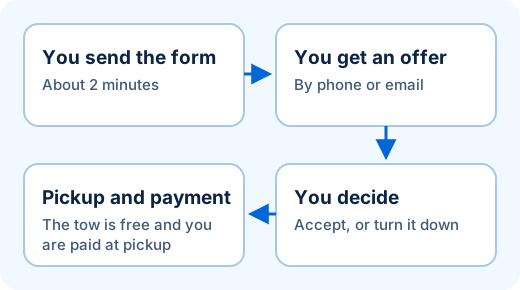
Through our cash for junk cars service, your request goes to our buyer partner. It makes the offer, tows the car at no cost to you and pays you at pickup, so start a free offer and set it next to any other quotes you have.
Frequently asked questions
Can I junk my car without a title?
Sometimes. Some states don't title older cars, and some licensed buyers accept a registration and photo ID for older vehicles. Otherwise, a duplicate title from your state's motor vehicle agency is usually the fix. Our guide to selling a junk car without a title covers the options.
How much will a junkyard pay to scrap my car?
For an older car that doesn't run, close to its metal value: about $310 for a midsize sedan and $450 for a pickup at $186 a ton (November 2026). Newer cars and cars that run can bring more, and a yard that tows may subtract the tow fee.
Do I have to be there when the junk car is picked up?
Usually, because someone has to sign the title and take the payment. If you can't be there, ask the buyer what they'll accept before you schedule the pickup.
Do I need to tell the DMV that I junked my car?
In many states, yes. Selling to a junkyard is still a sale, and Washington, for example, lists giving a car to a wrecking yard among the cases that need a Report of Sale. Check your state's rule and deadline in our title guides.